Photo: Andres Ortiz


Inspired by the origins of sushi (fast food), Detroit artist and chef Mike Han has developed a sustainable sushi concept called ITADAKU that will serve high quality sushi fast. This fine-casual sushi shop will feature Daku Maki (large format hand rolls), salads, and rice bowls along with traditionally made nigiri and sashimi.

ITADAKU is the intersection of Han’s two greatest passions, art and sushi. This concept is as much about art and storytelling as it is about eating for pleasure and sustenance. Itadaku is a Japanese word that means “to enjoy [food and life] with gratitude.” It is an honorific word that shows deep appreciation for the plants, animals and natural resources needed to nourish our bodies, and for the people who work the land and sea tirelessly to bring us nature’s bounty.

ITADAKU’s mission is to make delicious sustainable sushi accessible to all. Our broader goal is to positively impact people and our planet by cultivating grateful hearts. Like the city of Detroit, ITADAKU is founded in 1701 [Trumbull Ave], and with Detroit spirit and hustle, we will work to revolutionize the sushi industry by demonstrating a powerful demand for responsibly sourced seafood in the US and around the world.


Mike Han is the owner, chef and artist behind ITADAKU. Han was formerly the Head Sushi Chef of Roka Akor in River North Chicago, a Michelin recommended restaurant and ranked as one of the "Top 10 Sushi Spots in the US" by Bon Appetit Magazine. Han has also worked under Master Sushi Chef Katsu Uechi, one of four Master Sushi Chefs in LA at his restaurants Katsuya by Starck, and Katsu-ya, a perennial Top 10 Restaurant in SoCal rated by Zagat.

As an artist, Mike works under the name “icon” (say "Mike Han" really fast a few times and you'll get it) and has painted murals for vitaminwater, the Detroit Riverfront Conservancy on the Dequindre Cut, the Woodward Windows Project, Derrick May's Transmat Gallery, for several Metro Detroit businesses and even has painted a mural in Japan. Han has exhibited his artwork throughout Metro Detroit and in Seoul, South Korea, and has had artwork purchased for use in a feature film by Paramount Pictures.

ITADAKU is a singular Detroit experience coming to Corktown in late 2016.

Follow @itadakusushi on facebook and instagram for news and access to pre-opening pop ups and check out Daku’s Story on our website itadakusushi.com.

By Rick Merritt, Silicon Valley Bureau Chief, EE Times

Detroit's progress in diversity is a lesson it can give Silicon Valley in exchange for its example of passion for startups.

Just before the Fourth of July holiday, I got an email pitching a story about progress with the turnaround in Detroit, the city where I was born. I was especially intrigued because the email hit my iPhone just as I was heading to the San Jose airport for a flight to see family in Kalamazoo.

I recently got more details from Pam Lewis, director of the New Economy Initiative, a project of a nonprofit working on the turnaround in southeastern Michigan. Lewis said after the 2008 financial crisis, unemployment rose in Detroit to nearly 25% and poverty peaked at 40%. Even worse, 60% of residents of the Motor City don't own a vehicle, she said.

I’ve heard from friends and relatives for years about the down economy in Michigan generally. I witnessed it first hand the last two years trying to sell my aunt’s Kalamazoo home. Walking around my old neighborhood, I saw several houses shuttered, some badly in need of repair and selling under foreclosure for less than $40,000.

Silicon Valley entrepreneurs consider that a good down payment on a Tesla. The average San Jose home sells for twenty times that amount.

NEI provides some impressive figures of what it has helped achieve, especially in diversity, an area where Silicon Valley is more of a follower.

In recent years, NEI helped create 1,600 companies, 39% of them minority-owned, compared to a national average of 21%. In high-tech, 28% of the companies are minority and women owned, compared to 3-4% nationally.

In the last nine years, the number of startup accelerators and incubators in Detroit has risen to 50 from less than ten. And the amount of venture capital investment has nearly tripled in five years while the national numbers have declined, the NEI said.

Click HERE For The Full Article! 
A video posted by Wes Borland (@thewesborland) on

‘Sight Unseen’

DIY Network

10 p.m. and 10:30 p.m. Wednesday EST

Click HERE For More Information! 
Photo: David Gilkey/NPR
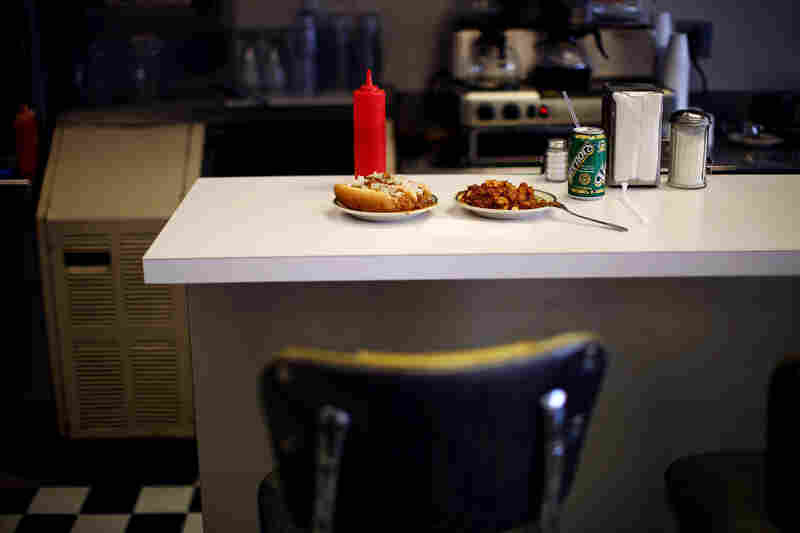
What does it mean to be middle class in America? Nearly a century ago, in Detroit — which was then the burning core of the country's middle class — the answer might have looked like a hot dog: a Detroit Coney, to be precise.

At its most basic, a Detroit Coney is a kind of chili dog — "a steamed bun, with a natural-casing hot dog, beef and pork," explains Joe Grimm, author of the book Coney Detroit. "And on top of that hot dog — which should be grilled, not boiled, not deep-fried — goes the sauce, the most important part."

All along the streets of Detroit, you see big neon signs advertising Coneys — a word that refers not just to the hot dogs but to the hundreds of eateries that sell them. Eateries like Red Hots Coney Island, which has been serving up Coneys since 1921.

Owner Rich Harlan has been working there for 48 years. He says his great-aunt and -uncle started the restaurant after immigrating to Michigan from Greece. "We are a block away from the first assembly plant that was made by Ford Motor Co.," Harlan says. "That's how they got started."

Indeed, the story of how the Coney became Detroit's signature dish is deeply entwined with the history of the city's auto industry.

In the 1920s and '30s, Detroit teemed with workers drawn there by Henry Ford's promise of a $5-a-day wage. "People came here from around the world to get that money," Grimm says. As a result, "the [city's] occupancy rate went over 100 percent." Housing became so tight that rooms were sometimes rented for eight-hour stints — long enough for one renter to sleep while another occupant was working a shift at the Ford factory, Grimm says.

Click HERE For The Full Article! 

The World Peace Mural Tour is coming to Detroit to create a "World Peace Mural" and is seeking volunteers who are willing to help with preparing the wall for the mural. 

VOLUNTEERS are needed on July 17th at 2:00pm
LOCATION: 4103 Grand River Ave., Detroit, MI 48208
The work to be done is fairly simple.
We are painting the whole building white.
Shouldn't take more than 4-5 hours
Maybe less, if we have more volunteers

Paint and supplies will be provided

If you have any of your own supplies, and are willing to bring them, that is greatly appreciated
(ladders, paint rollers, paint roller covers, paint pans, drop cloths)

Renda Writer is an artist from Miami, Florida, and he is coming to Detroit July 17-21st, 2016 as part of his World Peace Mural Tour.

The plan is to finish the preparation of the wall on July 17th, with the help of the volunteers, so that installation of the mural can begin on July 18th.

The World Peace Mural Tour is a peace campaign, art tour, and an effort to enact change through the energy of the written word, the power repetition, and the influence and interaction of public art.

More Info:
www.WorldPeaceMuralTour.com
www.Facebook.com/WorldPeaceMuralTour
Photo: Amanda Demme
Erykah Badu is supporting an effort to help get old rape kits tested.

The Detroit Free Press reports the singer partnered with The Right Productions to donate money from her Aug. 12 Detroit concert to the African American 490 Challenge.

The effort last year started urging black women to raise multiples of $490 — the cost of processing a single rape kit. The 490 Challenge is working with Enough SAID.

Shahida Mausi, president and CEO of The Right Productions, said the 490 Challenge would get $5 from each ticket and proceeds from two receptions with Badu.

"This is a huge day for Enough SAID/AA490,” said Wayne County Prosecutor Kym Worthy in a statement. “Everyone knows that Erykah Badu is a major, major talent in the music and song-writing industry. For her to lend her name, talent and time to this work is nothing short of a miracle. Justice for these forgotten sexual assault victims has been given a phenomenal assist.”

Michigan and the Wayne County Prosecutor's Office tested more than 10,000 kits dating back decades that were found in Detroit in 2009.

For information, call 313-393-0292 or go to www.CheneParkDetroit.com. Tickets for the Erykah Badu concert are available through Ticketmaster or via the Chene Park mobile app.

To donate to the AA490 Challenge, go to www.aa490challenge.org.


This Monday, The Children’s Center of Wayne County is teaming up with Slow Roll Detroit to bring awareness to the urgent need for Foster Parents in metro Detroit. 

Locally, more than 2,500 children are in the foster system. In Michigan, more than 14,000 children are in foster care each year. 

The July 11 Slow Roll will kick off from The Children’s Center campus in Midtown. For the second year in a row, this special ride will help bring awareness and attention to the thousands of Detroit children in foster care, and the need for loving foster parents. 

Riders will receive a blue Slow Roll for Foster Care Awareness t-shirt, and hear from TCC’s Community Outreach Specialist, Shereen Allen-Youngblood, as well Slow Roll as co-founder Jason Hall. 


A good number of fashion brands based in Detroit, touting the myriad ways they’re bettering the beleaguered city, have cropped up in recent years. Shinola is likely the most famous name heralding its “Made In Detroit” authenticity and its impact on the Midwestern metropolis (though that claim got thoroughly criticized, among other things, by The New York Times back in 2013). But there are some far smaller players doing big things in Motor City — like jewelry line Rebel Nell, founded three years ago by lawyer Amy Peterson, the Detroit Tigers' associate counsel.

Peterson came to Detroit to pursue a career in sports in 2007; getting involved with the local community led her inadvertently into the bauble business as a second job (a third job, really, counting motherhood, as Peterson puts it). Rebel Nell's cofounder and creative director, Diana Russell, had a design and retail background, but it wasn't a fashion project with a do-good element later tacked on. The cause — combatting joblessness for women in Detroit — truly begat the products.

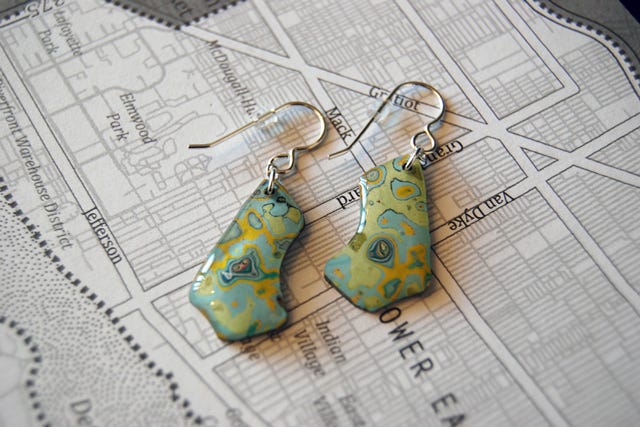
Beautiful as the slightly circuitboard-esque, marble-effect pieces are, it’s the company’s triple-pronged impact that really stands out. Firstly, Rebel Nell employs underemployed, impoverished women, and provides financial-literacy training, among offering other essential "getting through life" resources. The pieces these women create are basically wearable works of urban renewal, crafted from graffiti found around the city. Rebel Nell's offerings, priced at $60 to $175 per piece, bring further attention to the city itself and how revitalization efforts can (and should) take shape via fashion. (Last week, Peterson and Russell were named Social Entrepreneurs of the Year for their impactful work by Ernst & Young.) It’s the kind of altruistic project refreshingly devoid of bullshit; you can’t help but be inspired. We rang up Peterson to get the full story.


How did the concept for Rebel Nell come about? 

"I wanted to find my little way of giving back, and it kind of happened accidentally: Right next door to where I lived, there's a well-known shelter, COTS [Coalition On Temporary Shelter]. I'd walk my dog and have conversations with the residents, primarily the women. I heard their stories about the really challenging situations they left in search of better opportunity; even if that meant going to a shelter, they needed to leave whatever situation they were in. These were very courageous, motivated women, and I wanted to give them the tools needed to never be back in a shelter, ever again.

"A lot of what I heard was not only physical and emotional abuse, but they were escaping financial abuse as well. So I thought if I could give a financial-literacy component — understanding their bills, where their money was going — I could possibly help them. At that time, I didn't really know about social-enterprise work, but I wanted to find a way to support COTS with my friend and now business partner, Diana."

Click HERE For The Full Article! 
Photo: DEGC

Yesterday the City of Detroit announced the $52.4M investment to develop the Paradise Valley district surrounding Harmonie Park.

The teams include Hiram Jackson and his Paradise Valley Real Estate Holdings II LLC, Dennis Archer Jr., architect Rainy Hamilton, gallery owner George N'Namdi, Patricia Cole and Roger Basmajian of 311 E. Grand River LLC, and Ismail Houmani.

Developments:
  • Developing the Harmonie Club Hotel at 311 E. Grand River, where the Carr Center currently stands. This will be a boutique hotel that should be done in 2018
  • Building Hastings Place at 1468, 1480, & 1496 Randolph St. (where there’s currently a parking lot) that will include residential, parking, and retail. 17% will be designated for affordable housing
  • Expanding Hamilton Anderson Associates offices and opening the Paradise Valley Jazz Club at 1435 Randolph St
  • Developing 1407 and 1427 Randolph Street into a mixed-use development with restaurants (the "gateway from Gratiot" as Archer said in the press conference)
  • Additional residential space over La Casa de la Habana cigar shop at 1502 Randolph St.
Click HERE For More Information! 
Yoga At The Zoo! Returns July 9, 2016

Yoga At The Zoo! returns for another great morning of yoga, music and fun. From beginner to expert, Yoga At The Zoo! is for anyone who enjoys yoga or wants to try it.

Afterwards you can enjoy the Detroit Zoo at your leisure.

This is your chance to participate in one of the largest yoga events in Michigan.

More than 900 yoga enthusiasts attended last year! Join the fun and bring your family and friends to Yoga At The Zoo! 

Event Details 
Date: Saturday, July 9, 2016
Check In Time: 6:30am - 7:45am
Yoga Start Time: 8am

Location:
The Detroit Zoo
8450 West 10 Mile
Royal Oak, MI 48067

Click HERE To Reserve Your Spot! 


Partners Disagree on Where to Buy Loft in Detroit

A couple looks to purchase their first loft together in Detroit, but they can't agree on the location. One wants to be a part of the rebirth of the city and buy a loft with historic charm; the other would prefer to be in an already established, walkable neighborhood outside the city. Will they be able to come to a compromise and find the perfect home for both of them?

THURSDAY
Jun 30
10pm | 9c

From the Loft Warehouse:

Everyone knows the HGTV hit series, "HouseHunters", and many people know that The Loft Warehouse is the leading loft condo experts in Detroit - but did you know that we teamed up to bring you the season premier episode, airing on June 30th, at 10 pm EST, featuring the Coolest Lofts in Detroit !

This special episode showcases some of The Loft Warehouse's most coveted listings, and follows TLW President, Jerome Huez, as he introduces to his clients, a young couple from out of state, three distinct Detroit loft developments.

Watch the show to learn insider tips about the pro's ( and cons) of each location, and to see the difficult choices this couple face when deciding which loft to buy. And, let's celebrate the fact that Detroit real estate is enjoying some very positive attention in the national media, thanks to HGTV, and The Loft Warehouse.

If you miss the show when it airs, you can download and watch it here: http://goo.gl/usXrLj


top