Buzzfeed is asking members of their BuzzFeed Community what new Emojis should be created for their state.

Below are the results for Michigan!

Thanks for your suggestions, Michigan!

Click HERE For The Full Article!


Highland Park, Mich. - Her dream came in a nightmare.

When her baby was killed, Shamayim Harris looked around this city wholly surrounded by Detroit. No streetlights, no parks, no libraries. No place to be a child.

She began to dream. Be the change.

She bought a rundown house on Avalon Street. And then she bought the lot next door and made a park. She erected a solar street lamp. She mowed and cleared the lots on Avalon Street. She got abandoned houses torn down. Soon, the children came to camp overnight. Musicians came to play. And her dream began to grow.

The loss of a child set in motion a remarkable American story about humanity and perseverance and beauty of woman.

https://www.facebook.com/TheMoonMinistry/

https://www.kickstarter.com/projects/440111044/avalon-village-from-blight-to-beauty/updates
Photo: Getty Images
New York. Portland. San Francisco. Seattle. The debate rages on about the most innovative city in America. But if Google parent company Alphabet has its way, there soon may be a new contender.

Sidewalk Labs, which Google created last June and has since spun off as a subsidiary--is reportedly scouting locations to build an entire city, a highly connected utopia that will make the aforementioned cities look obsolete. Think: self-driving cars, high-speed Wi-Fi, internet of things-enabled everything.

According to The Information, the Denver and Detroit areas, so far, look like the frontrunners. Sidewalk Labs has consulted with more than 100 urban planning experts and forward thinkers, such as Anthony Townsend, research director of Institute for the Future. Sidewalk Labs already has some heavy-hitting city planners in its own ranks, including its CEO, Dan Doctoroff, a former New York City deputy mayor.

Google created Sidewalk Labs to confront the problems plaguing cities: traffic congestion, pollution, lack of public transportation, limited connectivity, to name a few. Its mission statement is to "accelerate innovation in cities around the world." What could that mean? Maybe a city with exclusively self-driving cars, clean energy sources, world-class transit hubs, and high-speed wireless, for starters.

Click HERE For The Full Article! 
PHOTO CREDIT: KEEGAM SHAMLIAN

Like most immigrants living in between two or three worlds, my relationship with the idea of home has always been complicated and messy. For much of my 20s, I spent most of my time on the road, without a permanent address, living out of an orange suitcase, with no real desire to settle down. But that lifestyle wasn’t sustainable for me, and so one year ago, on something of a whim, I applied to win a house. Today, I write this from the living room of my own home in Detroit, MI. I have achieved the American dream — at least part of it — in a very unusual way.

I was born to parents of Armenian descent in Iran in 1984; my family immigrated to the U.S at the height of the Iran-Iraq war in 1987. We had lived through the Iranian Revolution that had changed our homeland, and we came to America as refugees. We settled in Los Angeles, like many other Iranian and Armenian families did, to escape the violence and attempt to rebuild our lives. I learned English watching The Flintstones and The Jetsons, spent weekends navigating large family gatherings that included enough food to feed a small village, obsessed over the likes of En Vogue, and became a U.S. citizen at age 18.

My parents — along with many other immigrant families — reached a level of stability that allowed them to live comfortably and become homeowners. But for my generation, the economic crisis and rising housing costs meant that the same path was no longer a realistic option. This was especially true in L.A., the eighth most expensive city in the world. There, housing costs are so exorbitant, more than half of Angelenos can’t afford their rent, let alone owning a home.

I studied journalism in college and took a job working full-time at a media company. I spent long days editing material that didn’t excite me. I quit in 2011 to pursue a freelance reporting career that took me all over the world, but offered little pay. I was in love with the work and eked by, but there was no way I’d ever have the funds to buy a home. And that was fine for a while — until it wasn’t.

I didn’t really think I would win a home when I applied to the Write A House permanent residency program.

Click HERE For The full Article!  
Photo: ModelD Media 


MANY KINDS OF DIVERSITY

WE Labs is one of several new work spaces with public-service missions that include supporting low-income and minority entrepreneurs, artists, and social enterprises—nonprofits or for-profit companies that put social goals first. Some of these spaces, like maker-oriented Ponyride in Detroit, are nonprofits; several, like HQ Raleigh in North Carolina, and WE Labs, are for-profit social enterprises called Benefit Corporations (B Corps).

This nascent national trend has been locally focused. "I found that there were communities across this country that were struggling with the same kinds of questions of building their entrepreneurial ecosystems up and trying to figure out ways that they can make them be inclusive," says HQ Raleigh
cofounder Christopher Gergen, "but they weren't talking with one another." He hadn't heard of WE Labs, for instance, nor had Brown heard of HQ Raleigh. Gergen and others are starting to coordinate nationally with the Forward Cities Collaborative—an affiliation of organizations and activists in Detroit, Cleveland, New Orleans, and neighboring Durham, NC, that trade ideas on business development in low-income and minority neighborhoods.

"If you're a WeWork—which is in major metro markets like New York and Chicago and San Francisco, Hong Kong, Berlin, et cetera—it has a very different mandate and a very different strategy for where it's going to go," says Gergen. Communities outside the major commercial centers may have different types of businesses, he says. Health care and food and beverage companies are big in the Southeast, for example. HQ Raleigh's tenants include the venture arm of green household products company Seventh Generation, a coffee roaster, and plenty of tech startups.

Ponyride opened in the hip Corktown neighborhood of Detroit in 2011 as a maker space and light industrial facility, with small businesses, including a furniture maker, clothing manufacturers, and a screen printing studio. "I would say in the ecosystem of Detroit we're in the middle of the road of taking someone who maybe started a business in their basement or their kitchen and are ready to expand," says Amy Kaherl, director of programming. Kaherl is also a long-time tenant and director of Detroit Soup, which hosts dinners to raise money for creative projects pitched at the events.

Detroit Denim, for instance, joined in 2012 with one employee renting 400 square feet. Having grown to eight employees, it recently moved to a new location with 8,000 square feet. A nonprofit called "The Empowerment Plan" makes a coat from recycled materials that converts to a sleeping bag for homeless people; it mostly hires women from shelters, whom it helps get housing and further education. Ponyride's building also has a desk-based coworking portion that includes a journalist, a health coach, and the Detroit Public Theater.

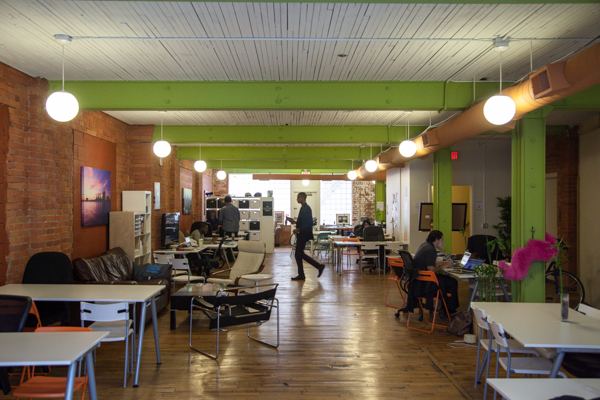
Even downtown Detroit's coworking scene looks different from what you might see in New York City or London. Bamboo Detroit has roughly 100 members ranging from Asia Newson, the 13-year owner of a candle-making company called Super Business Girl, to people in their 60s. About 45% of members are African American, and 40% are women, says CEO Amanda Lewan. Many Bamboo tenants are usual suspects for coworking spaces—such as game, app, and web developers and marketing consultants. It also has gigabit Internet provider Rocket Fiber and real estate developers jumping on Detroit's downtown boom.

Memberships start at just $99 per month for 24/7 access. Bamboo Detroit also offers several "open days" per month, when anyone can come in to work for free, as well as free events such as panel discussions and screenings of movies, often by local filmmakers or with a Detroit focus. The company turned a profit within about six months of opening, says Lewan. "We're a for-profit company with a social mission, and our mission is to provide an affordable option and to build a diverse entrepreneurial community," she says. Bamboo is incorporated as an L3C (low-profit limited liability company), a designation in Michigan and a few other states in the same spirit as B Corps, which are recognized in other states.

Click HERE For The Full Article! 


Detroit’s automotive history may have earned it the nickname Motor City, but the city is also renowned for a strong sports engine, fueled by a championship legacy of professional teams and local youth clubs, that never stops running. The May 26 opening of the Nike Detroit Community Store aims to both power and accelerate this legacy.

Nestled in downtown’s historic F.W. Woolworth Co. building, at 1261 Woodward Avenue, the space was once home to the eponymous pioneer of the five-and-dime stores, which converted the complex into a significant shopping destination at the turn of the century. More than 100 years later, Detroit is focused on reinvigorating the area by reanimating vacant buildings as businesses and residences, introducing a light rail that connects the neighborhood to the bustling midtown and developing a shopping and entertainment complex across the street from the Detroit Community Store. Plus, a world-class hockey arena will soon open just a few paces away.

“Sport is a cornerstone of our state pride," explains Tom Izzo, Michigan State University head coach and Basketball Hall of Famer. "Fostering early, positive experiences with physical activity is incredibly important for young adults, which is why I’m thrilled to welcome Nike to the city of Detroit."

As with other Nike Community Stores, the new space operates with four key goals in mind. The first is the aim to hire at least 80 percent of its team from within a five-mile radius of the location. In some locations, like at the Nike East Los Community Store in Los Angeles, this number is virtually 100 percent.
The second goal is to capture the spirit of the city with the store’s curated local design and product offerings. In the Detroit store, the walls feature photography of local sport courts and landmarks, including the Decquindre Cut Greenway, and "Detroit Never Stops" artwork by local typographer Neil Tasker. The store also carries Detroit-specific tee's and sports team apparel from the Detroit Lions, the Detroit Tigers and Michigan State University for men, women and kids.

Thirdly, the store distinguishes itself by ensuring that its retail associates, known as “store athletes,” have an opportunity to give back to the surrounding community. In addition to the hours dedicated to community by all stores as part of the Nike Community Ambassador Program, Community Store athletes are allocated additional volunteer hours to support groups in their backyard.
In fact, even before the store opened, the Detroit team was focused on engaging its community by volunteering with the local Boys & Girls Club chapter: the Diehl Club. Store athletes have been supporting the organization’s sport, recreation and fitness programming, including the chapter’s flag football program, as coaches and rec leaders, with plans to expand its community involvement further following the store opening.

Finally, beyond its on-ground community activation, the Detroit Community Store is the first Nike Community Store to offer $40,000 in annual grants of $5,000 each to eight local non-profit groups via the expanded Nike Community Impact Fund, which also includes Nike Community Stores in Portland, Ore., South Chicago, New Orleans, the Ivy City neighborhood of Washington D.C., Brooklyn and the East Los Community Store in East Los Angeles. In total, Community Store teams across the U.S. will award $290,000 each year in their communities in partnership with CAF America and the Oregon Community Foundation.

"By expanding Nike's Community Store concept to include local grant programs, we look forward to fostering even deeper connections that empower young leaders where our store teams live and work," said Dennis van Oossanen, VP and GM of North America Direct-to-Consumer.
Photo: Sugar House
THE HALL OF FAME
BY ALL RIGHTS, FIRST PLACE on any list of the best bars of the twenty-first century should go to Milk & Honey, founded in New York in 1999 by the late and much-lamented Sasha Petraske, who did more than anybody else to establish the parameters for the modern cocktail bar. Unfortunately, it closed a couple years ago, and there's no point in us listing a place you can't visit. That sends us—and, we hope, you—to Pegu Club. In our first Best Bars feature, we singled out this modern New York classic for proving that a bar today could do everything the legendary bars of the past could do. Years later, it's still doing that. Meanwhile, Pegu Club's bartenders have gone to every corner of America and opened their own bar, establishing the same thing over and over: Pegu was timeless when it opened, and it hasn't changed a bit. To sit there in the cool evening shadows sipping a Pegu Club Cocktail is to be drinking in 2006 or 1936 or 1916.

GENERAL EXCELLENCE

OLD-SCHOOL FUNDAMENTALS

AMBIENCE & HOSPITALITY

COCKTAILS & HOSPITALITY

AMBIENCE & COCKTAILS

Click HERE For The Full Article 
(WARNING:  It Will Make You Thirsty)


Comcast Business wireless solutions allow Milkhouse to offer fast, convenient service to customers with reliable POS systems and Internet capabilities.

Comcast Business provides a number of small business solutions best suited to your industry, company size and service needs. Find the one that's right for you.

Head over to the Comcast Business Community page where you will find great articles that can provide insight on the latest trends in the small business world. New articles are added almost daily, so always check back to see what the newest articles are: http://goo.gl/nzxtir


Comcast Business partnered with bloggers such as me for this program. As part of this program, I received compensation for my time. They did not tell me what to purchase or what to say about any product mentioned in these posts. Comcast Business believes that consumers and bloggers are free to form their own opinions and share them in their own words. Comcast Business’ policies align with WOMMA Ethics Code, FTC guidelines and social media engagement recommendations.


Global initiative celebrates entrepreneurs in Detroit May 23-27 

Detroit Startup Week, powered by Chase, will feature over 100 events with 2,500+ participants expected over five days. Marquee speakers include: 
Detroit’s inaugural Startup Week™ will be the largest first-year event in the global brand’s six-year history.
“Our city is unlike any other, with both ingenuity and a welcoming spirit, brilliance and grit, and opportunities abound. Detroit Startup Week™ is designed to glue together those opportunities, celebrate what’s already working, and lay the groundwork for what’s to come,” said Kyle Bazzy, lead organizer. 

Detroit Startup Week™, powered by Chase, celebrates and supports entrepreneurship in Detroit and beyond. All activities are free and startups, entrepreneurs, and enthusiasts are all welcome to attend to amp up their business skills, networks, and knowledge of opportunities in Detroit and the region. Ten learning tracks will be offered to entrepreneurs at all levels: technology, entrepreneurship 101, mobility, music, food-preneurship, art+design, civic innovation, neighborhood collaboration, social entrepreneurship and the Internet of things (IoT). 

“Entrepreneurs are playing an invaluable role in Detroit’s comeback,” said Jennifer Piepszak, CEO of Chase Business Banking, whose firm has committed $100 million over five years to Detroit’s economic recovery. “Detroit Startup Week™ is a great opportunity to recognize small businesses’ importance to the city’s recovery and to ensure they gain access to the necessary resources to support and grow.”

"More than a century ago, Ford Motor Company was a startup business that applied innovative thinking and collaboration to get where it is today,” said Bill Ford, executive chairman, Ford Motor Company. "We are proud to support the next generation of entrepreneurs at Detroit Startup Week who embody that same spirit."  

Sessions aligned with the ten tracks, including fireside chats and panels, networking opportunities, happy hours and even free headshots for entrepreneurs will round out the week. Events will take place all over the city at venues that include Civilla, Grand Circus, Techtown, Bamboo Detroit and more. Event headquarters are at the historic Masonic Temple, known for the week as #ChaseBasecamp.

To learn more to register for Detroit Startup Week, visit http://detroit.startupweek.co. 

Startup Week™brings entrepreneurs, local leaders, and friends together over five days to build momentum and opportunity around Detroit’s unique entrepreneurial identity. Detroit Startup Week is led by entrepreneurs and hosted in entrepreneurial spaces all over Detroit. Tracks include technology, entrepreneurship 101, mobility, music, food-preneurship, design/art, civic innovation, neighborhood collaboration, social entrepreneurship and the Internet of things (IoT). This Techstars initiative can be found in dozens of cities worldwide. Detroit Startup Week is powered by Chase and made possible by Ford Motor Company, Butzel Long, Microsoft, Liquor 43, Opportunity Detroit, Telemus, Social Enterprise Alliance Detroit, Billhighway, Solidea, Pixo Group, Detroit Regional Chamber and Verii. To learn more or register, go to http://detroit.startupweek.co.
top